Our UK network is live
July 2026 — In March, we wrote about taking control of the pipe: landing our own hardware at Telehouse, becoming our own carrier, and removing the layers between your ISP and Computle. In May, we set out how we would roll it out. This page brings those updates together with where the network stands today.
Why we did it
Traffic to Computle used to cross four or five carrier networks between your ISP and our data centre, each making its own routing decisions. We could optimise our end, and you could optimise yours, but we had no say in what happened in between. Rather than asking every customer to pay for a private link, we built one ourselves between Telehouse — the heart of the UK's internet — and UK-B. Your ISP hands off to us in London, and from there your traffic travels exclusively on our own dedicated 100G layer 1 fibre.
- No BGP hops: your ISP hands off to us at Telehouse, and it hits our fibre
- No congestion: it's a 100G circuit dedicated to Computle traffic
- No variance: no intermediate carriers adding delay between London and UK-B
We are now live on LINX
Computle (AS213513) is now a full member of LINX — the London Internet Exchange, where the UK's internet converges. Our first edge is colocated at Telehouse London, one of the UK's premier carrier hotels, where thousands of ISPs, carriers, and networks already have a presence. Via the LINX route servers, we peer directly with hundreds of UK and European networks.
When your ISP is on LINX, your traffic hands off directly to our edge at Telehouse rather than transiting through intermediate carriers. That means lower latency, no throttling, and more consistent performance — because no one in the middle is making routing decisions that affect your connection.
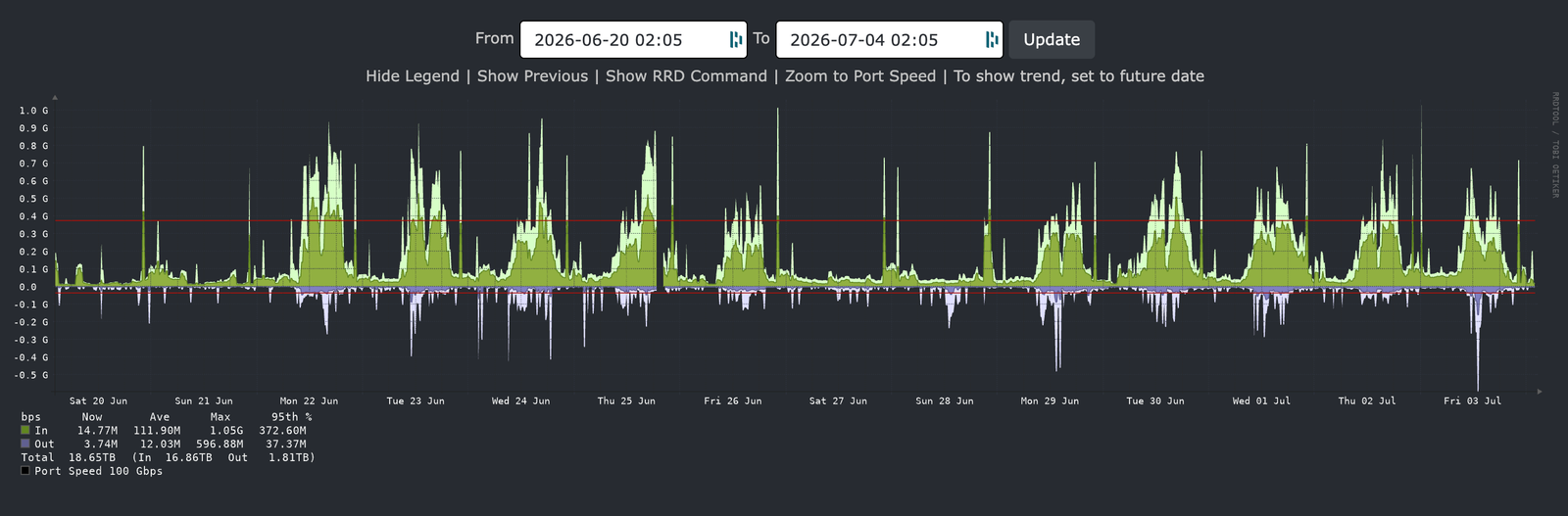
Our 100G private backbone
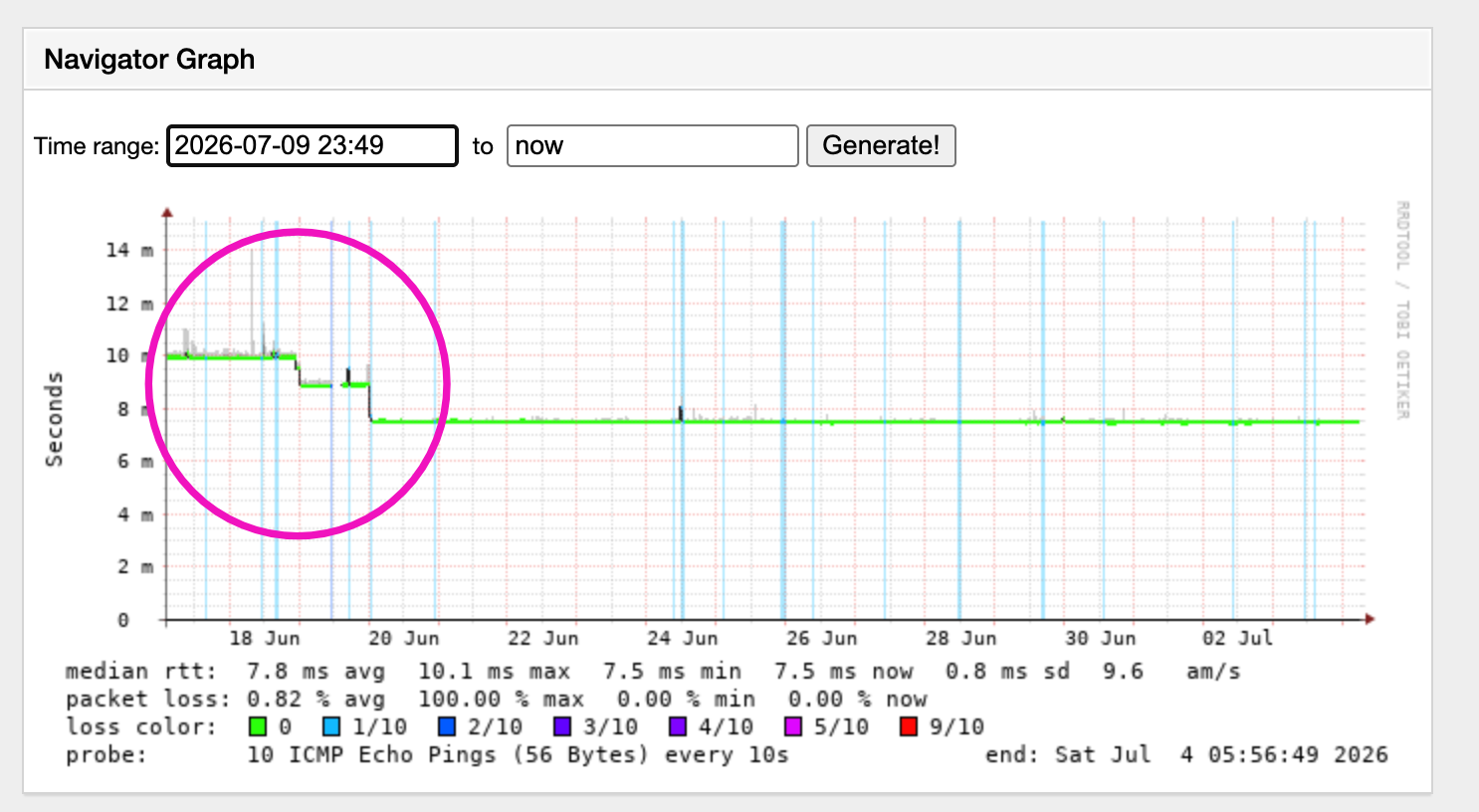
The private L1 fibre between Telehouse and UK-B is the first link in what becomes our 100G backbone. As you can see in the SmokePing data below, latency dropped the moment the link came live — and has stayed there. As we connect more sites on the same model, the backbone grows with it. Purpose-built capacity between our own facilities, carrying only Computle traffic, with nothing in the middle to add delay.
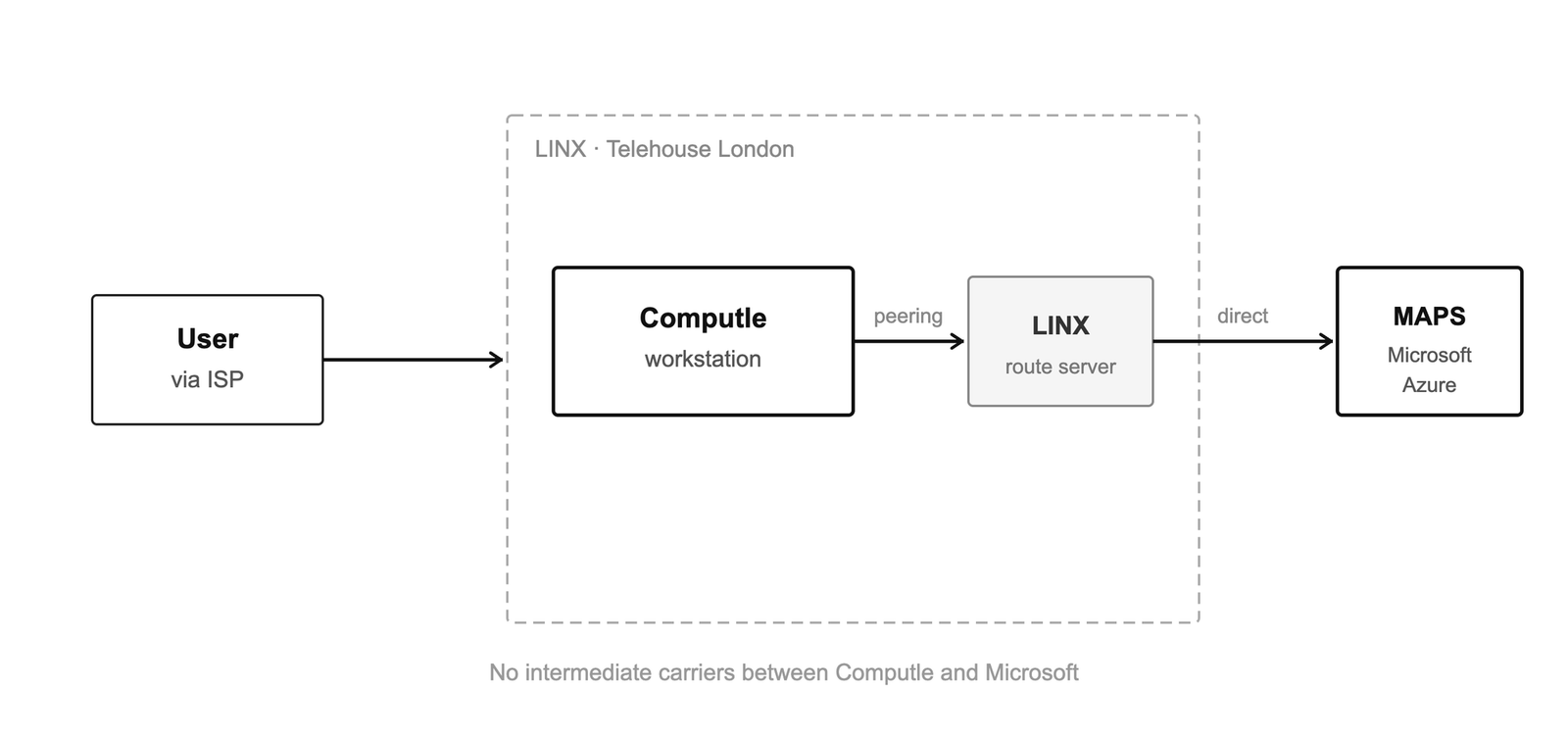
Direct connections to Microsoft, AWS, and the platforms you use
We've established a dedicated port with Microsoft and we connect directly to major cloud networks including AWS. If your project data lives in Panzura, Egnyte, or any platform hosted on those networks, it's travelling a more direct path to your workstation — fewer hops, lower latency, no carrier in between adding unpredictability. Same applies to Teams and Microsoft 365.
New transit: moving to Tier 1 only
We've added Arelion as a new transit provider at Telehouse and are consolidating onto Tier 1 carriers only — Arelion and Cogent — moving away from the Tier 1 and Tier 2 providers previously spread across our DCs. Combined with LINX peering for local traffic, this gives us better routes, lower latency, and optimised costs.
How the rollout works
The new infrastructure adds a second announcement point in London and a private fibre between the two sites, making Computle the carrier between Telehouse and UK-B. It also lays the foundation for connecting our UKA and UKC sites to the same carrier hotel.
Dual-site announcement
Our /24 is announced from both Telehouse and UK-B — peering at LINX in London and using our existing transit providers at UK-B. London networks peering with us at LINX send their traffic directly to Telehouse rather than crossing multiple carriers to reach UK-B, and from Telehouse it crosses our own fibre north. Networks without a LINX presence continue reaching us as before.
Our own traffic first
Before any customer traffic touches the new path, we move our own services onto it — monitoring, internal tooling, and so on. This validates the circuit under real load and catches operational issues before customers are affected.
Redundancy
- A backup tunnel between Telehouse and UK-B riding the public internet, ready to carry traffic if the primary L1 fails
- Automatic failure detection that shifts traffic to the backup in under a second
- Automatic route withdrawal as a final fallback if both paths fail, so traffic falls back to UK-B's transits cleanly rather than black-holing
In a fibre cut, customers see a brief increase in latency (the backup tunnel is slower than the dedicated fibre) for the duration of the outage. When the fibre is repaired, traffic shifts back automatically. No outage, no manual intervention.
Customer migration, one at a time
Customer traffic moves to the new path one customer at a time: we allocate a new public IP from our /24, served from both sites, then cut over the endpoint the customer connects to once the new IP is verified working. Before moving the next customer, we verify the previous one's latency improvement against their baseline. The old IP stays live during the migration window, so rollback takes minutes if anything looks wrong.
Measured, not assumed
For each customer migration, we record RTT, jitter, and path stability before and after. The target is a consistent ~7ms between London and UK-B, with no variance from intermediate carriers.
The bigger picture
The UK buildout — private L1 fibre between facilities, LINX peering, direct cloud connections — is now our global runbook. Every new Computle site follows the same model, and we're progressively connecting existing sites together via dedicated private circuits, reducing the reliance on third-party transit.